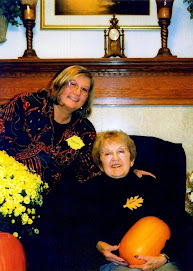
When I contemplated doing a Blog and feature my Mom, about a year ago, I discussed the idea with her, at the level I thought she could understand. When she said that it was a good idea, I asked her what I should write about. She looked me right in the eye and said "tell them we love each other." I need to remind everyone reading this Blog that I grew up hearing "I love you" very sparingly' not because my parents did not love us, but in the 50's this was said out loud much less than we now say it; just a sign of the times. It was very "cool" to hear Mom choose that topic.
That was a year ago, and Mom has progressed in her disease, but it gets even better. Now if things aren't going well, I can put on a big smile and and look at her squarely and in a few seconds she will say, "I love you". I never thought I would have a instant way to get my "love fix." Now I will say, Mom says "I love you" to others, not infrequently.
I could get bummed out about this, but, I have chosen to look at it as "Mom has a lot of love to go around, and after all I know she really does love me." The other question is why does she do this. Of course, we cannot know exactly why someone with Alzheimer's disease, does what it is they do. We cannot ever know why anyone does what they do, but there are a few clues. Mom always loved being the "healer", loved being the person that others "feel good." I believe this is her attempt to make me feel good, feel loved. Even though Mom is quite debilitated her basic personality is showing through in this gesture. This is often true in the behaviors of people with Alzheimer's. Their basic personality shows through if we are patient enough and creative enough to figure it out. I would encourage everyone to find the patience and creativity to do this, it is very rewarding.
Thanks, good night and may God hold you in the palm of Her hand.
Friday, March 12, 2010


Monday, March 1, 2010
Music-Noise and other Counter Intuitive Dementia Facts
Mom and Dad always loved music. In my early years it was the Country and Western. Now I am here to tell you it was the old time, very twangy Country and Western music, not the modern "cross over" that you now hear. The "tumbling, tumble weed" Hank Williams type music. Later they became "more enlightened" And played modern music like the Beetles!! Whether in the car, at home, or watching TV, we had music. Mom can sing the oldies with the best of them!!
Doesn't it make sense that the use of music would be therapeutic at meal times, during activities and during cares? It just makes COMMOM sense, doesn't it? Well the disease rarely makes common sense and this is true for music.
When you have Dementia, you can focus on only one detail at a time. No multi tasking here. If you are playing Bingo, and have Dementia, you need to concentrate on Bingo. The same is true of eating, you need to concentrate on eating. If you have Dementia, music in the background is simply noise, or worse yet, it is a distracting factor. Again, you can concentrate only on one thing at a time. Now if I am resting and have Dementia, the music is great, because I don't have to concentrate on anything else. Our loved ones have this request, "present me with one thing at a time and I can do pretty well!!" This a simple concept, but not an easy one to remember because it is so counter intuitive. It is important, however, for their highest quality of life and prevention of behaviors caused by the "overload" or over stimulation of trying to concentrate on two things at a time. Music at the right time is great, but knowing when it is the right time is, is most important!!
Thanks. May God keep you in the palm of her hand.
Doesn't it make sense that the use of music would be therapeutic at meal times, during activities and during cares? It just makes COMMOM sense, doesn't it? Well the disease rarely makes common sense and this is true for music.
When you have Dementia, you can focus on only one detail at a time. No multi tasking here. If you are playing Bingo, and have Dementia, you need to concentrate on Bingo. The same is true of eating, you need to concentrate on eating. If you have Dementia, music in the background is simply noise, or worse yet, it is a distracting factor. Again, you can concentrate only on one thing at a time. Now if I am resting and have Dementia, the music is great, because I don't have to concentrate on anything else. Our loved ones have this request, "present me with one thing at a time and I can do pretty well!!" This a simple concept, but not an easy one to remember because it is so counter intuitive. It is important, however, for their highest quality of life and prevention of behaviors caused by the "overload" or over stimulation of trying to concentrate on two things at a time. Music at the right time is great, but knowing when it is the right time is, is most important!!
Thanks. May God keep you in the palm of her hand.
Sunday, February 14, 2010
They Just Say "No"
I had breakfast with Mom this AM. When I have breakfast with Mom, I always get her coffee after we are finished. Today I asked her if she would like some coffee, and she said "No". I then, realized I needed to take my own advise-never ask a Yes /No question as people with Dementia/Alzheimer's Disease will almost always say No. I then got her coffee with milk and sweetener-The Irish way-she immediately started drinking it and said this is "great coffee."
Although this seems counter intuitive, it was quite predictable. I always tell our team members, "our residents with Dementia say no for a living" and the research supports this supposition. If the person says No, nothing is expected and this comfortable. If the person says Yes, they know at some level, that they may be required to do something and this is not comfortable. After lots of "No, don't do that", "stop, you are going the wrong way" and other failures, No is the most comfortable response.
It is important that those of us who care for and love someone with Dementia/Alzheimer's disease, that we need to approach the choice factor differently. If ,for instance, Mom had refused to drink the coffee, that would have been fine. This is Mom's level of ability to choose. Choice can be overwhelming to those with progressed disease, but by adapting and modifying choice, to the level the person can successfully tolerate, everyone can enjoy the interaction more and person with the diease will have the ability to chose and feel successful.
May God Keep you in the palm of Her hand!!
I had breakfast with Mom this AM. When I have breakfast with Mom, I always get her coffee after we are finished. Today I asked her if she would like some coffee, and she said "No". I then, realized I needed to take my own advise-never ask a Yes /No question as people with Dementia/Alzheimer's Disease will almost always say No. I then got her coffee with milk and sweetener-The Irish way-she immediately started drinking it and said this is "great coffee."
Although this seems counter intuitive, it was quite predictable. I always tell our team members, "our residents with Dementia say no for a living" and the research supports this supposition. If the person says No, nothing is expected and this comfortable. If the person says Yes, they know at some level, that they may be required to do something and this is not comfortable. After lots of "No, don't do that", "stop, you are going the wrong way" and other failures, No is the most comfortable response.
It is important that those of us who care for and love someone with Dementia/Alzheimer's disease, that we need to approach the choice factor differently. If ,for instance, Mom had refused to drink the coffee, that would have been fine. This is Mom's level of ability to choose. Choice can be overwhelming to those with progressed disease, but by adapting and modifying choice, to the level the person can successfully tolerate, everyone can enjoy the interaction more and person with the diease will have the ability to chose and feel successful.
May God Keep you in the palm of Her hand!!
Wednesday, January 27, 2010
The Roller Coster Continues
Mom is continuing to progress in her disease. She is less and less able to carry on a conversation or initiate a conversation. We are in her 7th year of actually knowing or having confirmed that that she has Dementia of the Probable Alzheimer's type. She probably had it for 3-4 years before this. So the fact that she has progressed is not a surprise. Mom will now answer questions almost exclusively most often with yes or no. A few days ago I was talking to her about my day, doing what we call "Storytelling". I then talked about what we would be doing tomorrow which was to polish her nails with the new "winter" color from the "Christmas red" which she had currently on her nails. When I finished, I said to her "does that sound like a plan?" She said "it sounds like something" with real emphasis in her voice and a big smile. Not a huge bit of conversation, but more than she has been able to do for several months. It made my heart sing. It was a small glimpse of "mom", a shadow of who she used to be!!
Now as we all know, joy is as stressful as a negative event. This comment by Mom caused a whole flood of emotions, love, tenderness, guilt-had I done enough?- could I do more next time and get the same or better results next time? I work everyday in the Dementia field and teach and counsel with families all the time, I still have the roller coaster ride as a daughter, when something like this occurs. I really want to say to all family and friends with people who have Alzheimer's Disease reading this, that when your roller coaster comes, don't fight it, but find a way to get out of it as quickly as possible. There may not be a way to totally prevent them. Knowledge, preparation, talking to others all help to flatten the lows and will help you to enjoy the highs. A few months ago I talked about the Dementia roller coaster, and I guess I now have begun to appreciate that the roller coaster continues, but I would not have it any other way.
May God keep You in the Palm of Her hand.
Now as we all know, joy is as stressful as a negative event. This comment by Mom caused a whole flood of emotions, love, tenderness, guilt-had I done enough?- could I do more next time and get the same or better results next time? I work everyday in the Dementia field and teach and counsel with families all the time, I still have the roller coaster ride as a daughter, when something like this occurs. I really want to say to all family and friends with people who have Alzheimer's Disease reading this, that when your roller coaster comes, don't fight it, but find a way to get out of it as quickly as possible. There may not be a way to totally prevent them. Knowledge, preparation, talking to others all help to flatten the lows and will help you to enjoy the highs. A few months ago I talked about the Dementia roller coaster, and I guess I now have begun to appreciate that the roller coaster continues, but I would not have it any other way.
May God keep You in the Palm of Her hand.
Monday, January 11, 2010
Alzheimer's Disease and Eating Diffuculties
Mom, until recently was able to inject quite a bit of humor in her conversation. A few months ago she looked across the table at the woman who sits across from her and said "she is so thin she looks like an xray". The irony of this comment comes from someone who weighs 92 pounds.
Eating difficulties and weigh loss are relatively common in Alzheimer's Disease. The damage in the brain affects the perception of food and hunger. In other words nothing smells or looks good. Hunger like pain may not be percieved for what it is. As the disease progresses the ability to remember what food is for is lost. Another eating problem which occurs in the disease is the inability to hold eating utensils, such a fork or spoon.
Chewing and swallowing problems also arise as muscle diffucuties in the throat and tongue arise. This slows the eating process and increases choking. It makes the meal process more problematic and less pleasureable. Eating becomes a chore for all involved, especially for the person.
Interventions which help with eating and prevent weight loss
1. Cue the person by eating with them to "rolemodel" the process
2. Make foods into finger foods so the person can help themselves as long as possible which perserves dignity and independence. This can be done by make most things into a "sandwich", including peas and mashed potatoes.
3. Remove distractions at meal time including music and TV. Even these are distractors to the brain which has diffuculty sorting out what is going on in the enviroment.
4. Take enough time for the eating process. Meals may take 30-40 minutes of eating time, but we must keep the food warm .
5. Add calories whenever possible. This can be in the form of butter on everything!! Lots of it! Also adding peanut butter on crackers or celery or high fat ice cream to Carnation Instant breakfast or Ensure.
6. Remember calories are king.
Meals are VERY important. Without this focus it leads to "failure to thrive" weight loss and a premature downward slide and loss of quality of life.
May God be with you and may She hold you in the palm of her hand.
Eating difficulties and weigh loss are relatively common in Alzheimer's Disease. The damage in the brain affects the perception of food and hunger. In other words nothing smells or looks good. Hunger like pain may not be percieved for what it is. As the disease progresses the ability to remember what food is for is lost. Another eating problem which occurs in the disease is the inability to hold eating utensils, such a fork or spoon.
Chewing and swallowing problems also arise as muscle diffucuties in the throat and tongue arise. This slows the eating process and increases choking. It makes the meal process more problematic and less pleasureable. Eating becomes a chore for all involved, especially for the person.
Interventions which help with eating and prevent weight loss
1. Cue the person by eating with them to "rolemodel" the process
2. Make foods into finger foods so the person can help themselves as long as possible which perserves dignity and independence. This can be done by make most things into a "sandwich", including peas and mashed potatoes.
3. Remove distractions at meal time including music and TV. Even these are distractors to the brain which has diffuculty sorting out what is going on in the enviroment.
4. Take enough time for the eating process. Meals may take 30-40 minutes of eating time, but we must keep the food warm .
5. Add calories whenever possible. This can be in the form of butter on everything!! Lots of it! Also adding peanut butter on crackers or celery or high fat ice cream to Carnation Instant breakfast or Ensure.
6. Remember calories are king.
Meals are VERY important. Without this focus it leads to "failure to thrive" weight loss and a premature downward slide and loss of quality of life.
May God be with you and may She hold you in the palm of her hand.
Wednesday, December 30, 2009
The Holidays With Alzheimer's Disease
The Holidays are moving forward and when you have someone with the disease, the Holidays are bitter sweet. Although the joy is still part of the season, the Holidays often are full of many bumps. Just before Christmas I was spending time with Mom and although I spend a hour or so each day, this day, as the 2 days before, I was only spending 30 minutes or so. I said to Mom, I have to go, I have so much to do. I love you." She looked up at me and said "if you loved me you would not go" At this very emotional time of the year, you can imagine how difficult this comment was. Although I tell families all the time "it is the disease talking, not your loved one" It is different when it is your Mom. It is true, however, that Alzheimer's Disease causes people to do and say things they would never have done without the disease.
Let's discuss some things which can help us to decompress from the "Holiday Stress" over the next several weeks.
1. For any parties, family celebrations or other gatherings, remember they do not have to be perfect. Don't create your own stress
2. Try to keep things simple.
3. Phase the festivities in and out. The best way to not end up depressed and with a sense of loss, is to not take away ALL of the holiday trimmings at once.
4. Use the traditions of the families. This is helpful to you and for your loved one with the disease.
5. Get enough rest, exercise, and fluids. Over eating, too much coffee, and inactivity, all are forms of stress in their own right and take their toll at this time of the year for you and your loved one.
Take care of yourself. May God keep you in the palm of Her hand
Let's discuss some things which can help us to decompress from the "Holiday Stress" over the next several weeks.
1. For any parties, family celebrations or other gatherings, remember they do not have to be perfect. Don't create your own stress
2. Try to keep things simple.
3. Phase the festivities in and out. The best way to not end up depressed and with a sense of loss, is to not take away ALL of the holiday trimmings at once.
4. Use the traditions of the families. This is helpful to you and for your loved one with the disease.
5. Get enough rest, exercise, and fluids. Over eating, too much coffee, and inactivity, all are forms of stress in their own right and take their toll at this time of the year for you and your loved one.
Take care of yourself. May God keep you in the palm of Her hand
Tuesday, December 8, 2009
Alzheimer's Medications: What makes a differance?
One of the requests made RE Research in our last poll was to talk about medications and their impact on the quality of life for the Alzheimer's Disease survivors. A while ago mom said to me, "you are a sweet heart" and I replied "you are a sweet heart also". She looked back me for a few seconds and then said "I guess we are just a couple of sweet hearts!!" Before Mom was put on her current Alzheimer's med, she was unable to inject this humor into a conversation.
The current Alzheimer's medications help to slow the decline of the disease. I help Directors manage residents behaviors and these medications have a positive impact. We also see a profound decline in the cognitive functioning in those who are taken off the med. Additionally more behaviors occur and they often seem to just enjoy life less. The common myth says "there comes a time when the person with Alzheimer's disease no longer gets benefits from these medications". Both the research and our experience shows discontinuing the med will precipitate a huge and very steep decline.
In our next posting, we discuss other Medications which make a difference. May God bless you and hold you in the pal of Her hand.
The current Alzheimer's medications help to slow the decline of the disease. I help Directors manage residents behaviors and these medications have a positive impact. We also see a profound decline in the cognitive functioning in those who are taken off the med. Additionally more behaviors occur and they often seem to just enjoy life less. The common myth says "there comes a time when the person with Alzheimer's disease no longer gets benefits from these medications". Both the research and our experience shows discontinuing the med will precipitate a huge and very steep decline.
In our next posting, we discuss other Medications which make a difference. May God bless you and hold you in the pal of Her hand.
Subscribe to:
Posts (Atom)

 Posts
Posts